


Aug 24, 2026
WBHM.org: Proposed Data Centers Could Draw More Power Than All Alabama Homes Combined
A report by Lee Hedgepeth, published on WBHM.org on August 22, found that Alabama now faces more than a dozen proposed data center developments, stretching from Bessemer to the Black Belt. Built to full capacity, those developments together would consume more electricity than all the homes in Alabama combined.
Who pays for it?
Alabama Power's answer is that residential customers don't have to worry.
Large-load customers, the company says, pay the full cost of serving them. The mechanism behind that promise is the electric service contract, and those contracts require Public Service Commission approval.
Alabama Power filed one of them in the Commission's current docket. It covers the 300-megawatt Birmingham data center in Oxmoor Valley.
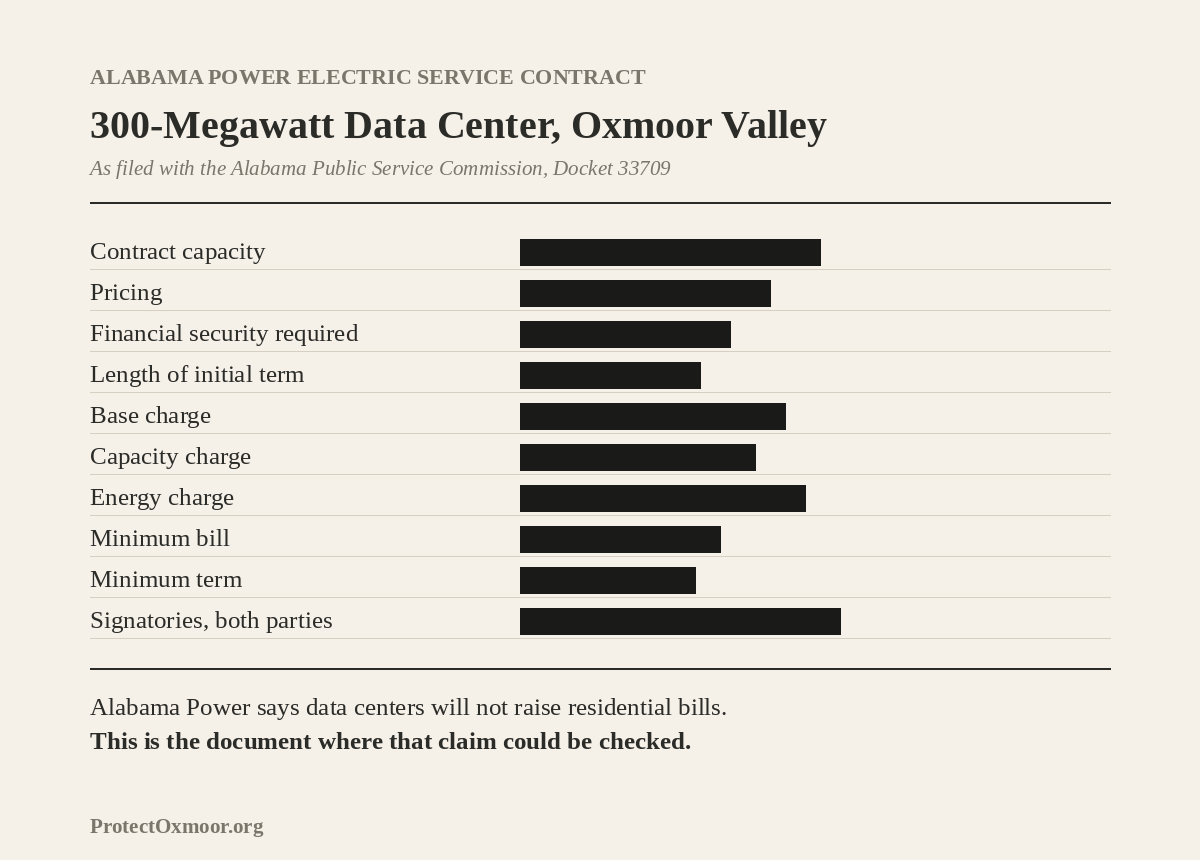
The filing runs twelve pages and discloses almost nothing about what either party has agreed to.
Ratepayer Lucille Kimble-Foster wrote in her docket comment that the contract capacity is redacted. So is the pricing. So is the required financial security.
The length of the initial term is blacked out, along with the addenda that describe the facilities and set the base charge, the capacity charge, and the energy charge.
The minimum bill and minimum term provisions are blacked out as well, and those are the two mechanisms Alabama Power points to publicly when it says other ratepayers are protected.
Even the names of the people who signed it are shielded, on both sides. The company's cover letter tells regulators the contract is in the public interest and complies with state law.
But the public is not allowed to know.
A new state law, SB 270, takes effect October 1. It directs the Commission to consider whether a large-load contract recovers the incremental cost of serving a data center and whether it benefits the utility's other retail customers. The Commission opened Docket 33709 to build the procedures for that review.
Daniel Tait of Energy Alabama told reporter Lee Hedgepeth that how much the statute actually protects customers depends entirely on how the Commission chooses to enforce it.
Jaclyn Brass of the Southern Environmental Law Center said that letting Alabama Power rely on custom contracts negotiated behind closed doors is too great a risk and argued for a public process in which the Commission hears evidence and sets a data center rate in the open.
One point in the docket bears directly on Oxmoor.
Alabama Power has told the Commission it believes projects that already hold local approval would not be subject to any new process created under SB 270.
In her comment, Kimble-Foster called that a loophole and asked the Commission to stop approving new large-load contracts until the stricter standards apply.
But set the legal argument aside for a moment and consider the arithmetic.
Taken together, the proposed projects would add more demand than all Alabama households consume today. Meeting it requires new generation and an expanded grid. Common sense says someone has to pay to build both.
Alabama Power's rate freeze holds residential rates steady through 2027.
As part of the freeze agreement, the utility delayed charging customers for a $622 million natural gas plant it bought in 2025 to meet demand driven largely by data centers. That charge is now expected in 2028. It would add an estimated $3.32 a month to the average bill.
None of those numbers are redacted. They are the ones the company chose to publish.