


The Oxmoor Covenant
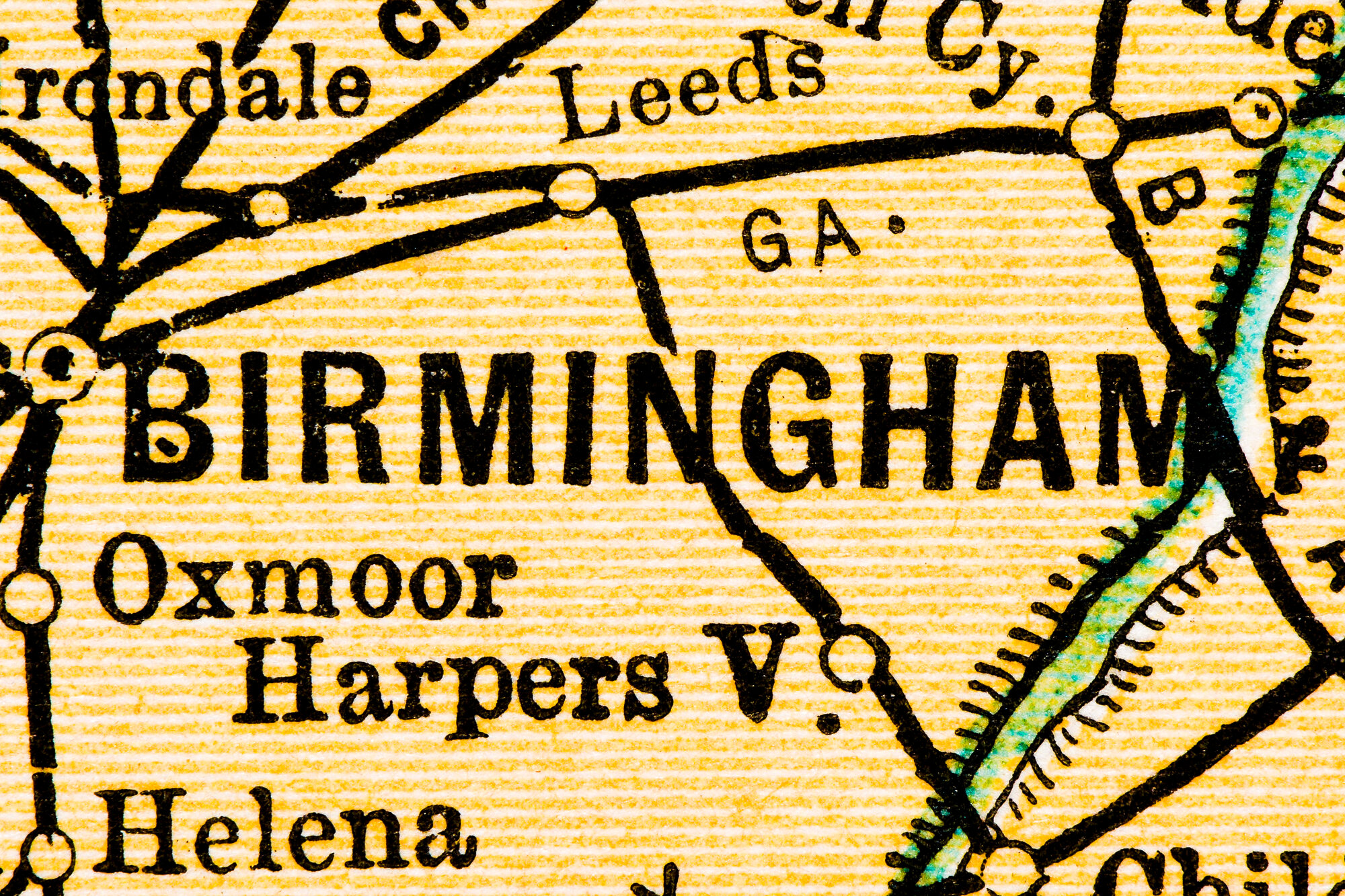
I. The Valley Before the City
Before there was a city, there was a valley.
Jones Valley ran east to west between two ridges. To the south rose Red Mountain, a long spine of Silurian rock stained red by the iron ore that laced it. To the north rose the gentler rise that would one day hold the city's first streets. Between them: farmland, creek bottoms, hardwood stands, and a slow-moving stream called Shades Creek that wound down toward Oxmoor.
The Cherokee and the Creek knew the red stone of Red Mountain long before settlers arrived. Farmers worked the lowlands. The land was quiet.
And under that quiet, the valley held a secret. It held the only place on Earth where coal, iron ore, and limestone, the three raw materials needed to make iron, sat close enough together to make a city out of them. The people who lived in Jones Valley did not yet know what they were sitting on. Within a generation, the whole country would.
II. The First Fire
In 1863, in the valley south of Red Mountain, a group of investors built the first blast furnace in Jefferson County. They called it the Oxmoor Furnace. It supplied iron to the Confederacy: cannon, shot, railroad spikes, the machinery of a war.
This was eight years before Birmingham was founded.
In March 1865, Union cavalry under General James H. Wilson swept south through Jones Valley on their way to Selma. Wilson's troops burned the Oxmoor Furnace to the ground. It sat in ruins.
Birmingham was incorporated on December 19, 1871, at a railroad crossing a few miles north. A new city, its streets drawn before most of its buildings stood. But Birmingham almost failed. By the mid-1870s, a cholera epidemic and the Panic of 1873 had nearly emptied the young city. The railroads were broke. The promise of iron that had brought investors had not been fulfilled.
Then in 1876, at the rebuilt Oxmoor Furnace, a small group of Birmingham businessmen ran one more experiment. Everyone else had given up. The furnaces had failed. The money had run out. People said Birmingham was finished before it had really begun.
These men asked one more question: Could local coal, turned into coke, smelt local iron ore?
The answer came in a column of smoke and a run of pig iron.
Yes.
And with that yes, Birmingham became The Magic City.
The city was founded at a railroad crossing. The valley at Oxmoor is what made the city survive. Everything that followed, the steel mills, the railroads, the company towns, the Black neighborhoods that rose up around the mines, the immigrant neighborhoods that rose up around the mills, the twenty-six-ton cast-iron statue of Vulcan that still stands on top of Red Mountain today, all of it traced back to that fire at Oxmoor.
III. The Long Quiet
For sixty years, the valley burned.
The Oxmoor Furnaces ran, with interruptions, until 1927. Henry DeBardeleben worked them. Daniel Pratt invested in them. James Sloss cut his teeth there before building his own furnaces a few miles north. The men and women who made Birmingham, enslaved men, then freedmen, then generations of Black and white workers laboring side by side in the heat, pulled ore out of Red Mountain for more than a hundred years.
Many of them never left. The Oxmoor Furnace Cemetery, where miners and their families are buried, still sits quietly inside what is now Red Mountain Park. You can walk there. You can stand where they stood.
Then the world changed. The furnaces were dismantled in 1928. Steel moved elsewhere. The Great Depression came. Mining continued on Red Mountain, but more slowly, more expensively, less profitably. In 1962, the last ore mine closed.
The valley went quiet again.
U.S. Steel owned most of the former mining land. Mead Paper owned much of the rest. The great stacks were gone, the workers were gone, the trains stopped running. For nearly half a century, the land that had given birth to Birmingham's second chance sat empty, thousands of acres of former industrial land, grown up in second-growth forest, waiting for someone to decide what it should become next.
IV. The Decision
In 1975, under Mayor David Vann, the Birmingham City Council passed a resolution annexing ten square miles of Oxmoor Valley into the city.
U.S. Steel and Mead Corporation sued to block the annexation. The Alabama Supreme Court sided with Birmingham.
The city's reach had grown. The question was what to do with it.
The answer came together over the course of the 1980s under Mayor Richard Arrington. It was not one decision. It was the product of years of meetings, negotiations, hearings, and master-planning sessions that built, piece by piece, a comprehensive vision for a 7,800-acre valley.
Five partners sat down at one table:
- The City of Birmingham
- Jefferson County
- The Metropolitan Development Board
- The University of Alabama at Birmingham
- The City of Bessemer
And the major property owners of the valley joined them, including U.S. Steel, which a decade earlier had been suing Birmingham to stop the annexation. The fight was over. Now the question was what to build together.
Together, the City, the County, and the partners hired HOH Associates of Denver, one of the leading land-planning firms in the country. The planners divided the valley into clusters, influenced by the new urbanist idea that neighborhoods should be walkable, mixed, and human-scaled.
A light industrial cluster along Lakeshore Parkway, for distribution centers and logistics. A mixed-use employment cluster, for corporate offices and research. A village center cluster, for retail, hotels, and housing. A planned mixed-use residential cluster, woven around a golf course, walking trails, and homes.
Four clusters. Different uses. Different scales. Different neighbors. Each one designed to sit next to the others without breaking them.
And then the City of Birmingham and Jefferson County did the thing that mattered most. The thing most cities never do.
They wrote the Plan into law.
Both Birmingham and Jefferson County designated Oxmoor Valley as a Mixed-Use Zoning Overlay District, the MXD. They drafted development guidelines. They created a Development Review Board, which became the Oxmoor Steering Committee. They published the map. The MXD overlay is still the law today.
The roles were distinct, and they were honored:
The City of Birmingham and Jefferson County wielded the zoning code. They alone had the authority to write a master plan into law and to enforce it through approvals.
The landowners wielded the land itself. U.S. Steel and the other property owners agreed to the Plan, participated in shaping it, and then honored it through the disposition of their own land over decades.
Both kept their word.
That is the Oxmoor Covenant.
It was never written in a contract. It was written in a master plan, sealed in a zoning code, and kept by everyone at the table.
V. They Came
Then people came.
Bruno's came first. The Birmingham-born grocery empire needed a distribution center, and the city assembled the land. Bruno's arrival triggered the annexation of 2,500 more acres of former Mead Paper land into the city. Bruno's was followed by Vulcan Lands, SONAT, and other names along the light-industrial cluster, all arriving because the Plan told them where to go.
Parisian came home. Founded in downtown Birmingham in 1887 by the Sommers sisters, Parisian had grown into one of the South's great department stores. In 1988, Parisian, Inc. built a 290,000-square-foot headquarters and distribution center at 750 Lakeshore Parkway in the Oxmoor Industrial Park. A four-story office wing. A warehouse connected by a fifty-foot glazed rotunda. An auditorium. A cafeteria. One hundred original works of art, commissioned from a young Birmingham painter named Jon Coffelt, hung on the office walls.
Birmingham's hometown department store, anchored in Oxmoor Valley.
In 1997, a Tennessee retail company called Proffitt's moved its corporate headquarters to the Parisian building. The next year, Proffitt's merged with Saks Fifth Avenue of New York to form Saks, Inc., and for nearly a decade, one of America's major department-store holding companies ran its business out of 750 Lakeshore Parkway. Saks Inc. stayed at Oxmoor until 2007.
The same building today houses the Birmingham Laboratories and Medical Devices Innovation Center of Evonik Industries, a German life-sciences company investing in Birmingham because the Plan said a mixed-use employment cluster belonged right there.
In 1994, the City of Birmingham transferred 50 acres to create the UAB Research Park. More jobs. More research. More of what the Plan had promised.
VI. The Golf Course That Saved a State
And then came the golf course.
In the late 1980s, Dr. David G. Bronner, the CEO of the Retirement Systems of Alabama, the pension fund for every public employee in the state, every teacher, every librarian, every state trooper, had an idea inspired, of all things, by a movie. Field of Dreams had just come out in 1989. Kevin Costner had built a baseball diamond in a cornfield because a voice told him to. Bronner watched it and thought: what if Alabama did that, but with golf?
Use pension-fund money. Build championship public courses across the state. Put Alabama on the golf map. Attract retirees. Attract tourists. Attract industry. The stronger the Retirement Systems can make Alabama, Bronner said, the stronger the Retirement Systems will be.
Jefferson County legislators and business leaders came to Bronner in 1989 and said: Oxmoor Valley.
Bronner agreed. The Retirement Systems of Alabama would fund construction and operations. The City of Birmingham and Jefferson County would build the access roads and utilities. And U.S. Steel donated 650 acres.
Robert Trent Jones Sr. was 86 years old. He had designed more than five hundred golf courses in a fifty-year career. He had mostly retired. Bronner asked him to come back and design a whole system of them, to be built simultaneously, a feat of architectural ambition no one had ever attempted. Jones accepted. He said he wanted courses you could play the U.S. Open on.
In May 1992, Oxmoor Valley, the very first site on what became the Robert Trent Jones Golf Trail, opened to the public. The Ridge Course. The Valley Course. A par-3 short course. A 35,000-square-foot clubhouse with a wrap-around veranda. Three more Trail courses opened that same year across Alabama. Oxmoor was the first.
The Wall Street Journal called the Trail one of the best bargains in the nation. Nearly twelve million rounds of golf have been played on it since. It transformed Alabama tourism. Mercedes and Hyundai both cited the Trail among the reasons they chose to build plants in Alabama.
And in Oxmoor Valley specifically, six hundred homes were built in the years that followed, homes with young couples and growing children and golf clubs in the garage, along with commercial and industrial development, all on the strength of what the Plan had said this valley would be.
In 2005, the partnership extended two miles south to Ross Bridge in Hoover. U.S. Steel donated another 328 acres to the Retirement Systems of Alabama for a second Trail course. U.S. Steel donated another 87 acres to the city of Hoover for a parkway, a performing arts center, a fire station, and an elementary school.
A steel company gave land away so children would have a place to learn.
VII. The Gift
And then came the largest gift of all.
In 2005, the Freshwater Land Trust announced that U.S. Steel would sell 1,108 acres of former mining land on Red Mountain, the same Red Mountain whose iron ore had made Birmingham the Magic City, to be preserved forever as a park. The land was appraised at $16.5 million. U.S. Steel sold it for $7 million, roughly half its value. And then U.S. Steel added $1 million in cash to help build the park's amenities.
The Freshwater Land Trust called it the largest philanthropic gift in U.S. Steel's 100-year history.
In 2006, the Alabama Legislature added the land to the state parks system and created the Red Mountain Greenway and Recreational Commission. In 2009, the City of Birmingham and U.S. Steel executed a land swap that added 50 to 60 more acres to the park, including the Oxmoor Furnace Cemetery, where the miners who built Birmingham are buried. They came home.
In 2012, Red Mountain Park opened to the public. Fifteen hundred acres. Seventy-eight percent larger than Central Park in New York City. Eighteen miles of hiking and biking trails. Historic mining artifacts. Tree houses. A six-acre off-leash dog park named for a beloved rescue. A sensory trail designed for visitors with limited vision. All of it free.
The park that Birmingham built on the ashes of the mines that built Birmingham.
VIII. Lives, Woven In
And all the while, families were moving in.
The apartments along Milan Parkway filled with residents. Single-family homes went up along Sydney Drive, Venice Road, Shannon-Oxmoor Road, street by street. Oxmoor Elementary School opened its doors. Children walked to class. Lunch boxes. Backpacks. The low hum of a school bus at the corner.
In the historic Pleasant Valley community within the Oxmoor neighborhood, Black congregations that had held worship for generations kept their doors open. Church vans in the parking lot on Sunday mornings. Hymnals softened by use. Hand fans moving in the heat. Old bricks. New voices. The unbroken line of people who had been here before the furnaces closed, who stayed when the valley went quiet, and who still gathered every Sunday to sing.
A whole resort community grew at Ross Bridge. The Stonegate apartments leased on the strength of being in the Oxmoor and Lakeshore corridor. Young professionals. First-time renters. Retirees.
On the Homewood end of the corridor, Samford University's Lakeshore campus, designed in consultation with the Olmsted Brothers in the 1950s, continued to grow. In 2016, Samford's College of Health Sciences moved into the former Southern Progress buildings on Lakeshore Drive. Nurses trained there. Pharmacists trained there. Therapists, chaplains, public health researchers.
Down the road, Jefferson Metropolitan Park Lakeshore welcomed Southern Company, Blue Cross Blue Shield, Wells Fargo, and Oxford Pharmaceuticals: 337 acres of corporate investment, every company pulled in by the strength of the Plan.
And the Plan is still working. Right now.
On April 23, 2025, the Birmingham Subdivision Committee unanimously approved Redding Ridge, a 497-home residential subdivision on 196 acres adjoining Red Mountain Park, off Sydney Drive, with a commercial district facing Lakeshore Parkway at the Sydney Drive roundabout. On May 22, 2025, the developer purchased the land from U.S. Steel Corporation for seven million dollars, the same price U.S. Steel had charged the Freshwater Land Trust in 2005 for the land that became Red Mountain Park. The same corridor. The same seller. The same promise, still being kept. The Redding Ridge site is zoned MXD, the same Mixed-Use Zoning Overlay District the Plan created. The development is approved for a six-year buildout, from 2025 through 2031. Four hundred and ninety-seven families will build their lives there on the strength of that Plan.
And in this decade, the Greater Birmingham Humane Society, founded in 1883, one of the oldest humane organizations in the country, decided to come to Oxmoor Valley too.
Not a shelter carved out of an old warehouse. A purpose-built, multi-building medical and community campus, designed around the belief that animals deserve the same quality of care, space, and dignity that human beings would want for themselves.
A large animal care and control facility, already built, already operating. A spay-neuter and critical care veterinary teaching hospital for fourth-year veterinary students from schools across the Southeast. Outdoor surgical viewing areas for educational programming. An adoption and placement center. Foster and transport hubs. A community training facility. A cat café and retail space. An outdoor plaza and hardscape. Walking trails planned to connect to Red Mountain Park.
The campus was sited at the corner of Milan Parkway and the Oxmoor corridor, directly across from 201 Milan Parkway, where Regions Bank had operated its Lakeshore Operations Center, a 315,000-square-foot corporate office building, since the corridor was built out under the Plan. A bank. An office. In the mixed-use employment cluster. Exactly where the Plan said a corporate office should be.
GBHS invested $77 million. The first building is already built. Two more are planned. Architects, veterinarians, board members, staff, donors, volunteers, an entire institution's future, wagered on the same promise every family, every school, every congregation, every golf course, every park, and every other institution in the valley had wagered on for four decades:
The Plan is the law. Oxmoor Valley is what the Plan said it would be. Birmingham will keep its word.
IX. The Arrival
And then one day in early 2026, a foreign-headquartered company called Nebius Group N.V., based in Amsterdam, showed up.
Nebius had bought roughly 80 acres at 201 Milan Parkway, the former Regions Bank campus, for about $90 million. They announced plans to demolish the 315,000-square-foot bank operations building and replace it with a 300-megawatt AI factory. By their own promotional materials, a hyperscale compute campus. It would require a dedicated substation. A switching station. Transmission towers up to 125 feet tall. Industrial-scale cooling. Generator arrays. Continuous 24/7 operation, every day of the year, for as long as the facility stood.
Not an office use. Not a bank-operations use. Not a light-industrial distribution-center use.
Not anything the MXD framework was built to permit.
A heavy industrial use.
Directly across the street from homes. From an elementary school. From congregations gathered on Sundays. From a golf course that the Retirement Systems of Alabama built with pension-fund money, that U.S. Steel donated 650 acres for, and that Robert Trent Jones Sr. came out of retirement to design. Adjacent to a 1,500-acre state park built on what was once the largest philanthropic gift in a century of U.S. Steel history. And across from a humane society campus designed around outdoor animal yards and walking trails that were supposed to connect to that very park.
Nebius asked the City of Birmingham for two special exceptions, one for the switching station, one for the substation, because neither use, on its face, was what the zoning allowed.
In February 2026, the Zoning Board of Adjustment first took up the requests. Residents packed the room and raised concerns about environmental impact, noise, and safety. The Board delayed action.
On March 26, 2026, the Board took the cases up again.
The rule is plain. Under Alabama law and the ZBA's own published Rules of Procedure, a special exception requires the concurring vote of two-thirds of the members present. You do not vote to deny. You vote to approve. If the motion to approve fails to clear two-thirds, the request is denied by operation of the rule. A deadlock is not an approval.
On the switching station, four members voted to deny. It was denied outright.
On the substation, three members voted to approve with conditions, one voted against, and one abstained. The motion needed four votes. It got three. It failed.
Both requests were denied.
That should have been the end of it.
X. The Memo
But fourteen days later, on April 9, 2026, the Birmingham City Attorney issued a memorandum.
In the first half of the memo, she acknowledged what the rules required. The substation motion had "failed to meet the required threshold for approval." The statement made at the meeting that the substation had been approved, she wrote, "was in error." The substation was denied. The switching station denial stood.
Then the memo pivoted.
Having just confirmed that both applications had been denied, the City Attorney announced a new conclusion. Her office, she wrote, had determined that the Zoning Board of Adjustment had never had jurisdiction to begin with. The reasoning: the Zoning Ordinance defines a "utility substation" as a facility distributing services to "individual neighborhoods." Because Nebius's substation and switching station would serve only Nebius, not a neighborhood, they were, by her reading, not "utility substations" at all. And therefore, she concluded, "these matters should not have been before the Zoning Board of Adjustment."
Read carefully, the logic of the memo is this:
The applicant asked for special exceptions. The ZBA denied both. Therefore the applicant did not need special exceptions.
Six days after the memo, on April 15, with nine days still left on the window to appeal the memo itself, the Planning Department issued Nebius a building permit.
On April 24, 2026, the Greater Birmingham Humane Society's attorneys at Spain & Gillon hand-delivered notices of appeal to City Hall. They asked the Zoning Board of Adjustment to stay the building permit or issue a stop-work order.
Because if the buildings go up before the appeals are decided, the appeals are meaningless.
The Covenant is broken by a backhoe, not by a vote.
XI. What We Are Asking
This is the Oxmoor Covenant.
It is not a piece of paper. It is not a recorded deed restriction. It is older and bigger than that.
It is the Plan the City of Birmingham and Jefferson County wrote.
It is the zoning the City of Birmingham and Jefferson County adopted.
It is the land U.S. Steel donated and sold.
It is the pension-fund money the Retirement Systems of Alabama invested.
It is the course Robert Trent Jones came out of retirement to build.
It is the park the Alabama Legislature chartered.
It is the school that opened.
It is the homes families bought.
It is the congregations that gathered on Sundays.
It is the corporate offices that filled.
It is the research park that grew.
It is the 497 homes Redding Ridge will build over the next six years.
It is the Humane Society that is committed to a $77 million medical-model campus on the belief that the Plan was the Plan and the word was the word.
It is the word Birmingham gave to everyone who believed the City.
The Zoning Board of Adjustment took these concerns seriously. It delayed in February. It denied on March 26.
Nebius is asking the City of Birmingham to treat those denials as if they never happened.
We are asking the City of Birmingham to do the opposite. To honor the rule. To honor the vote. To honor the forty years of trust that built this valley into what it is today.
To keep the Covenant.
The Oxmoor Covenant. Keep the Promise. #KeepTheCovenant
The Oxmoor Covenant FAQ
Q: Is the Oxmoor Covenant a legal document?
No. The Oxmoor Covenant is not a recorded deed restriction or a signed contract. It is the forty-year civic agreement that was written into the Oxmoor Master Plan, sealed in the Mixed-Use Zoning Overlay District (MXD), which is still the law today, and honored through decades of decisions by the City of Birmingham, Jefferson County, the State of Alabama, U.S. Steel, the Retirement Systems of Alabama, and every family and institution that built their lives here in reliance on it.
A covenant in this sense is a civic and moral commitment. Like the Mayflower Compact. Like a church covenant. It is older than a contract and, in many ways, stronger.
Q: Wasn't Oxmoor Valley always industrial? Isn't this just the next chapter?
Oxmoor Valley's industrial past is not in dispute. The Oxmoor Furnaces operated from 1863 to 1927, and the 1876 coke experiment at Oxmoor is what made Birmingham economically viable and earned it the name The Magic City. What happened next is the point.
Over forty years, Birmingham, Jefferson County, U.S. Steel, the State of Alabama, and private philanthropy made deliberate, documented decisions to transform Oxmoor Valley into a mixed-use community corridor. U.S. Steel made the largest philanthropic gift in its 100-year history to create Red Mountain Park. The State added it to the state park system. The county adopted mixed-use zoning protections. The Robert Trent Jones Golf Trail opened. Six hundred homes were built. Schools opened. An Amsterdam-based 300-megawatt AI factory is not a continuation of that plan. It is a reversal of it.
Q: Aren't you just NIMBYs?
A NIMBY opposes development on principle. We do not. Homes, schools, corporate offices, research parks, distribution centers, a golf course, a state park, a university, and a humane society campus have all been built in Oxmoor Valley in the last forty years, all in reliance on the same Plan we are defending today. In April 2025, the City unanimously approved a 497-home subdivision next to Red Mountain Park under the same MXD framework.
What we oppose is a heavy industrial use being dropped into the mixed-use employment cluster of the MXD overlay, where the zoning has said for forty years that heavy industrial uses do not belong.
Q: Don't we need economic development? What about the jobs?
Hyperscale AI factories are notoriously low-employment. Industry sources commonly cite roughly one employee per megawatt, or fewer. A 300-megawatt facility may generate a few dozen full-time jobs once operational, while consuming electricity equivalent to a small city.
By comparison, the Parisian headquarters at 750 Lakeshore Parkway employed hundreds. Saks Inc. ran a Fortune 500 retail empire out of that same building. The Greater Birmingham Humane Society campus will generate jobs in veterinary medicine, education, community training, and animal welfare.
The Covenant is not anti-development. It is pro-the-right-kind-of-development.
Q: Didn't the ZBA approve the substation?
No. The ZBA first heard both special exception requests in February 2026 and delayed action after residents raised concerns. At the second hearing on March 26, 2026, the ZBA denied both requests.
Under Alabama law and the ZBA's own Rules of Procedure, approval of a special exception requires the concurring vote of two-thirds of the members present. On the switching station, four members voted to deny. On the substation, three members voted to approve with conditions, one voted against, and one abstained. The City Attorney's own April 9 memorandum concedes this, stating the prior announcement of approval “was in error.”
Both requests were denied. The permit was issued anyway.
Q: Why are you fighting this after the ZBA vote?
We are not fighting the ZBA vote. The ZBA voted in our favor. It denied both requests. What we are fighting is the April 9 City Attorney memorandum that seeks to erase those denials, and the building permit issued six days later, while nine days still remained on the window to appeal the memo.
Q: Isn't this just about GBHS protecting its campus?
The Greater Birmingham Humane Society has invested $77 million in reliance on the same Plan that protected every family and institution in Oxmoor Valley. But the Covenant is bigger than any one organization. It is the promise Birmingham made to every homeowner along Sydney Drive and Venice Road, to every family whose child walks into Oxmoor Elementary, to every congregation that has gathered in Pleasant Valley for generations, to every institution that built in Oxmoor on the strength of the Plan.
Q: What do you want the City to do?
Three things.
- Stay the building permit (BLD2026-00640) until the appeal of the April 9 City Attorney memorandum is fully heard.
- Honor the ZBA denials of March 26, 2026, as final under the ZBA's own Rules of Procedure and Alabama Code § 45-37A-56.
- Protect the Mixed-Use Zoning Overlay District that Birmingham and Jefferson County wrote into law forty years ago, and that thousands of families, businesses, schools, and institutions have relied on ever since.
Q: Who speaks for the Oxmoor Covenant?
The Oxmoor Covenant is a coalition effort led by the Oxmoor Neighborhood Association. Public questions can be directed to ONA through its president, Madelyn Green. Matters specifically about the legal appeal or the GBHS campus can be directed to the Greater Birmingham Humane Society through its CEO, Allison Black Cornelius. Legal matters related to the ZBA appeal should be directed to attorney Brian Cash at Spain & Gillon, LLC.
Q: What can I do to help?
The Oxmoor Covenant. Keep the Promise.