


Jun 11, 2026
The City Passed Its Data Center Ordinance. What It Does and What It Took Away.
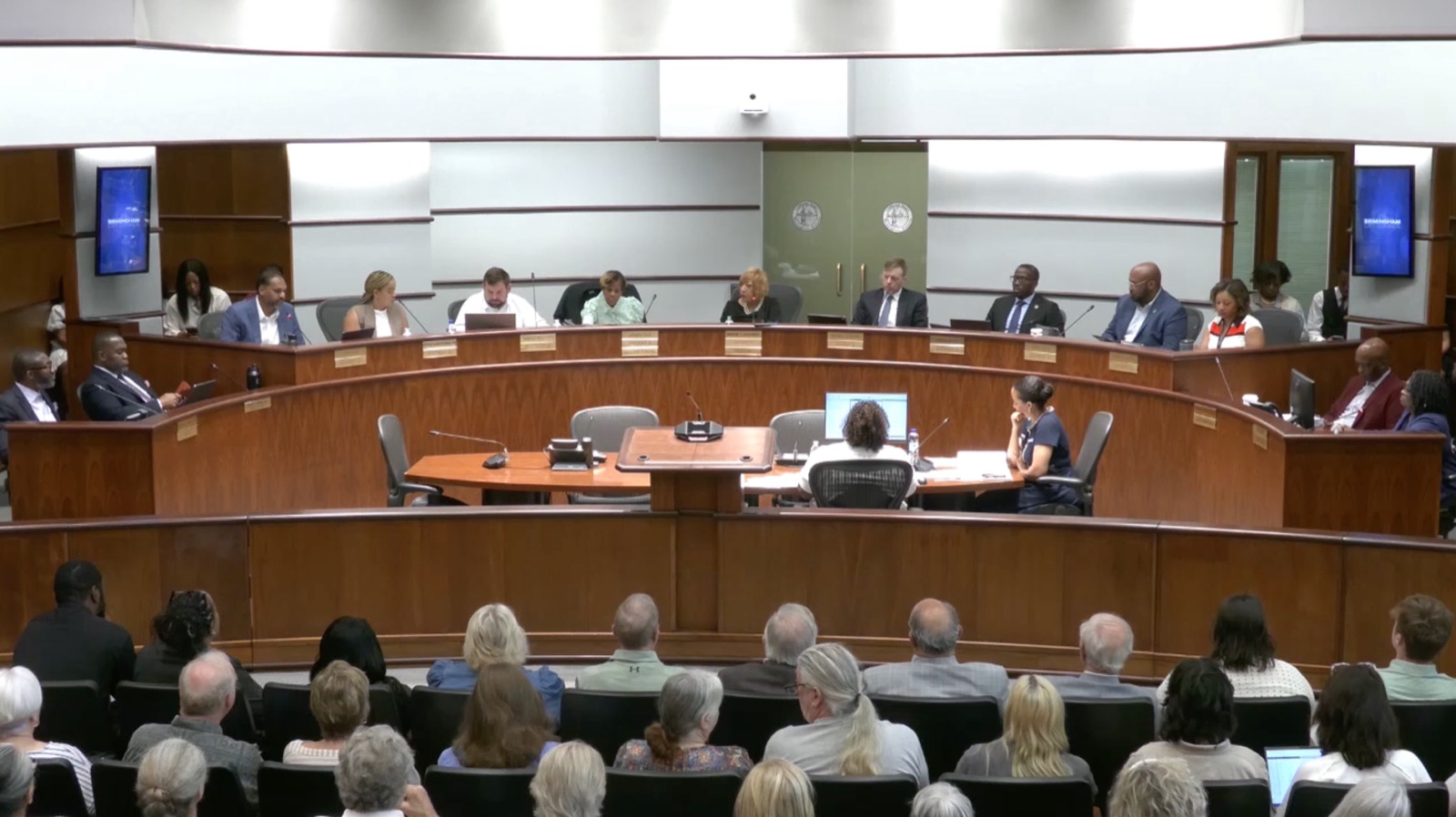
On Tuesday, June 9, after a public hearing that ran nearly four hours, the Birmingham City Council passed the city’s first data center ordinance.
Hundreds of residents came to City Hall. The council chamber filled, then two overflow floors filled, and people waited outside in the heat for a turn at the microphone.
Speaker after speaker — homeowners, teachers, nurses, veterinarians, business owners, neighborhood presidents, and environmental organizations including the Southern Environmental Law Center, Black Warrior Riverkeeper, the Alabama Rivers Alliance, and GASP — asked the Council for the same things, in remarkable agreement.
The Council heard them and then passed the ordinance without the changes they asked for.
The June 9 meeting was long, technical, and easy to misread. Here is what the ordinance does and does not do, what it means for Oxmoor Valley, and what to watch for now.
What the Council voted on
The ordinance amends Birmingham’s zoning code to define every category of data center, from small fiber huts up to hyperscale facilities, and attaches twenty conditions to the hyperscale category: the industrial-scale AI mega factories that have raised concern across the country.
The conditions cover electrical demand disclosure, closed-loop cooling, water use reporting, backup generators, landscaping and screening, lighting, and a five-acre minimum lot size.
Some of the ordinance’s provisions are genuinely meaningful. We will give the city credit where it is due, but we will be equally precise about where the ordinance falls short.
The biggest change: no more public hearings
The single most consequential change in the version that passed is what it removed.
The earlier draft required a special exception for hyperscale data centers — the step that triggers a public hearing before a project is approved.
The version passed on June 9 eliminates that requirement. Under the new ordinance, a developer that meets the twenty conditions on paper simply files for a permit. No hearing. No notice to the broader community. No chance for those most affected to at least have their concerns heard.
Residents asked overwhelmingly, in person and in writing, for the special exception to be restored before the vote. It was not.
Neighboring cities have reached the opposite conclusion: Hoover, Columbiana, and Athens all require a special exception (and the public hearing that comes with it) before a data center can be approved.
The irony of June 9 should not be lost. The last public hearing Birmingham may ever hold on a hyperscale data center was the hearing about ending them.
City staff characterized the resulting ordinance as “one of the strongest in the nation.” It is anything but.
500 foot setbacks, when residents asked for 1,000
The ordinance sets both the residential setback and the notification radius at 500 feet.
Residents asked repeatedly for at least 1,000. For perspective: 500 feet is about a block and a half, and the same ordinance requires 1,000 feet of separation between a data center and a transit station.
Under this ordinance, your home would have to settle with half the buffer of a bus stop.
The 500-foot framework also makes no specific provision for institutional neighbors — schools, hospitals, daycare facilities, facilities serving people with disabilities, or animal shelters — places where the people and animals affected cannot simply move away from constant industrial noise, heat, and emissions.
If a hyperscale data center, like the Nebius AI Mega Factory, comes to your neighborhood, you may not even know it until it is too late.
Written notice by certified mail goes only to property owners within 500 feet of a proposed site.
That means a facility drawing the power of a small city can be approved with formal notice to a handful of property owners, while everyone else who will live with its noise, heat, and traffic learns about it after the fact.
What the ordinance does for Oxmoor
Here is the part that matters most to our neighborhood, stated as precisely as we can state it.
The AI Mega Factory under construction off Lakeshore Parkway is exempt from this ordinance.
The City claims it was grandfathered before the city’s moratorium took effect, and nothing passed on June 9 would apply the twenty conditions to it as currently permitted.
At first glance, the ordinance does appear to do one important thing.
The City Attorney confirmed it on the record.
Now that the ordinance has passed, any material change or expansion by an existing facility will require resubmission and compliance with all twenty conditions.
So, if Nebius wants more floor area, more megawatts, more water, more cooling capacity, more generators or fuel storage beyond what its permit initially approved, it will have to comply with the same twenty conditions applied to future hyperscale data centers, as detailed in the new ordinance.
The catch is the people who will evaluate the new application are the same people who overruled the Zoning Board of Adjustment and let Nebius proceed as if their application was consistent with zoning in Oxmoor.
Even though it wasn’t.
What public input is left
Because this question will matter for years, here is the complete list of what remains, taken from the city’s own statements at the hearing.
A future hyperscale developer must send certified-mail notice to property owners within 500 feet.
A public hearing occurs only in these narrow circumstances:
-
If the project requires lot consolidation, a resurvey, or right-of-way changes that trigger the subdivision process
-
If the property sits in an I-3 planned manufacturing district, which requires Zoning Advisory Committee review
-
If the developer fails one of the twenty conditions and asks the Zoning Board of Adjustment for a variance
-
In Oxmoor’s mixed-use district, through review by the Oxmoor Steering Committee.
A development that meets all twenty conditions on a properly configured lot will not have to undergo a public hearing.
Mayor Randall Woodfin committed that any data center seeking city incentives or a support letter to the Industrial Development Board must first hold a public meeting.
That commitment deserves to be noted, but also to be understood for what it is. It is administration policy, not law. It was not written into the ordinance, it binds no future administration, and a developer that wants no incentives never faces the public at all.
What remains unresolved
Residents raised a consistent set of concerns at the hearing that the ordinance, as passed, does not answer. We list them here because they form the agenda for what comes next.
Noise. The ordinance requires noise studies but sets no enforceable limit — no number a facility must actually meet.
City staff and the City Attorney agreed at the hearing that real decibel limits are needed and said they belong in the city’s general noise ordinance, which they acknowledged needs a full overhaul. No timeline was given.
Meanwhile, the continuous noise source at a hyperscale facility is not the backup generators the ordinance walls off. It is the cooling fans, which can run day and night and face no enforceable standard, including for the low-frequency sound that travels farthest and affects children, medically fragile people, and animals most.
No decommissioning bond. Nothing in the ordinance requires an operator to post financial security for cleanup if the technology changes or the company leaves.
Birmingham knows what abandoned industrial sites look like. The ordinance leaves that door wide open.
Plans instead of policing. The twenty conditions are reviewed before a permit is issued, but the ordinance contains no ongoing independent monitoring, no inspection schedule, no penalty structure for a facility that stops complying after it is built.
Residents asked for annual inspections at the operator’s expense and meaningful fines for violations. Neither is in the ordinance.
In other words, we are left hoping corporations comply.
No independent review. Every study the ordinance requires — noise, water, traffic — is produced by the developer’s own consultants. Residents asked for third-party review selected by the city, at the applicant’s expense. The ordinance does not provide it.
No baseline testing. The ordinance requires no measurement of air, water, soil, or groundwater conditions before construction. Without a baseline, no one can later prove what a facility changed, and the burden of proof falls on residents.
Definitions that can be gamed. The size categories use an “and/or” test that can place one facility in two categories at once, and the ordinance’s own anti-evasion language, which counts a project’s total electrical demand regardless of phasing or ownership structure, is not applied everywhere a megawatt threshold appears.
Under the ordinance, a developer can arguably split one large project into phases or separate legal entities to stay under the thresholds that trigger the strongest conditions.
City staff acknowledged at the hearing that definition revisions are coming. We will be watching for them.
Battery storage and fire readiness. The ordinance permits on-site lithium-ion battery storage subject only to an emergency response plan reviewed by the fire department.
It requires no applicant-funded risk assessment and no funding for the specialized training and equipment Birmingham Fire and Rescue would need to fight a battery fire, a hazard documented at data center sites in Oregon and California in the past two years.
Your electric bill. The ordinance requires applicants to disclose rate impacts. It does nothing about them.
Transparency on the exempt project. The expansion trigger only works if the public can see when an expansion is filed.
Residents are entitled to know whether any current or exempt project has explored expansion, increased megawatts, permit amendments, or changes in scope — and the city should make that information public as a matter of course.
What we will be watching
The Council said on the record that this ordinance is not written in stone and can be revised.
We intend to hold the city to that, on a schedule.
Specifically, we will be watching for:
-
A published date for the noise ordinance overhaul, with real, enforceable decibel limits measured in a way that captures the critically important low-frequency range
-
The definition revisions city staff promised, including applying the aggregate electrical demand language everywhere megawatt thresholds appear
-
Any permit amendment or expansion filing by the exempt project — which, as of June 9, must comply with all twenty conditions
-
Ultimately, we need restoration of the special exception, so that the people of Birmingham are never again removed from a decision of this scale.
Stay informed
The June 9 vote settled one ordinance. It did not settle the question of whether Birmingham residents get a voice in what is built beside their homes.
Protect Oxmoor will continue to serve as a central source of accurate, documented information on this issue — for Oxmoor Valley and for every Birmingham neighborhood that could be next.
Sign up for email updates, follow Protect Oxmoor on Facebook and Instagram, and join with us.
The hearing room may be closed. We are not.